
She Gave Me My First Real Chance. They Made Me Box Up Her Office.
The day I learned what “stepping on toes” really means.


I could feel the room before I knew the reason I’d been called into it.
A narrow side office. No windows. Carpet that swallowed footsteps. The kind of place managers use when they want the conversation to feel smaller than it is.
The door closed with that soft, final click — the one that tells you the outcome has already been decided.
The manager sat across from me, hands folded, expression flat. I stayed standing a second too long, realizing the geometry of the room wasn’t an accident: wall behind me, desk between us, nowhere to go.
Then they said it. I had been “stepping on toes.”
The words came out calm and deliberate. The kind of accusation that doesn’t invite a defense.
I hadn’t raised my voice. I hadn’t missed a deadline. I hadn’t ignored direction. I was doing what I’d been hired to do: keep things moving, fix what was broken, make sure the work didn’t stall.
But in that cramped room, under fluorescent light, I was being punished for it.
The rest of the conversation blurred: a steady loop of implication without specificity. I remember nodding, saying little, waiting for the moment when they’d finally let me leave.
When I finally stepped back into the hallway, I felt a sick, sinking realization that I’d seen this before.
Early in my career, I was still figuring out how offices worked — the titles, the politics, the invisible lines that decided who mattered. I showed up early, stayed late, said “yes” to everything. That’s how you learn, or at least how you think you do. Every task felt like a small audition for belonging.
The woman who hired me ignored all that. She saw potential, not polish. She didn’t gatekeep. In an industry where people often hoarded information to make themselves indispensable, she did the opposite: she shared everything she knew. She gave me resources, walked me through what I didn’t understand, and never made me feel small for not knowing. She wanted everyone to succeed.

Her office was the heartbeat of the floor. People came and went constantly: assistants, editors, producers, even execs. It was a revolving door, but not in a chaotic way. It was the place to be. Everyone who passed through seemed to have their own shorthand with her — an inside joke, a shared story, a nickname only she used.
Then, one morning, during what should have been a routine meeting, her name came up in passing.
“She is no longer with the company.”
No pause. No explanation. Said like a calendar update.
The day before, she’d been in her office laughing about a rough cut. The next, she was gone — erased with the same tone used for delivery deadlines.
When the meeting ended, I went straight to a coworker’s office, someone who’d been close to her. I wanted to believe it wasn’t true.
But when he looked up and met my eyes, his face fell.
That was all the confirmation I needed.
A few minutes later, the same manager who’d made the announcement called me in again.
Yes, she was no longer with the company — and someone needed to pack up her office.
That someone was me.
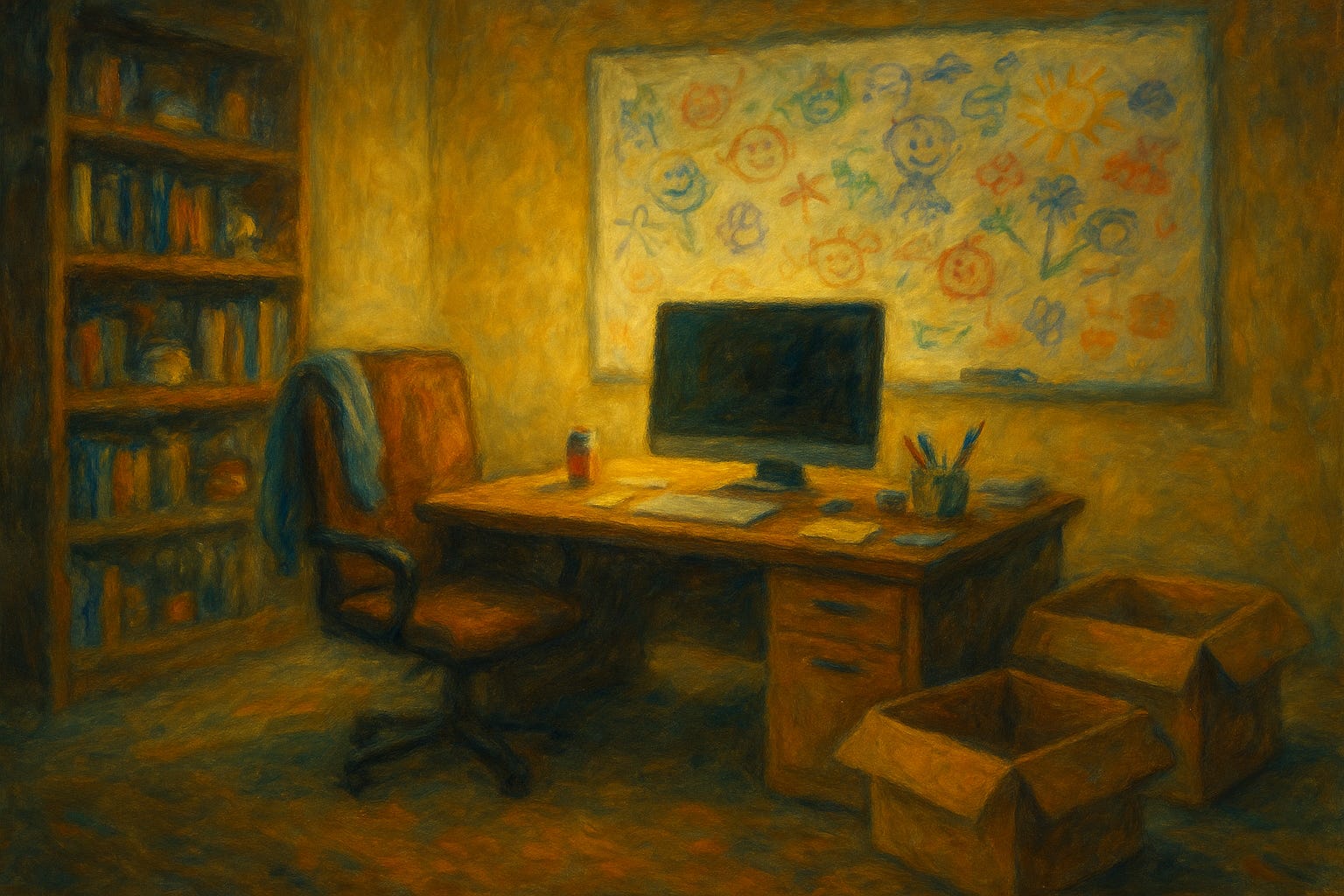
The door was half open when I got there.
Her chair was slightly turned, a sweater still hanging on the back. Papers on the desk, perfectly aligned. A half-finished soda beside a stack of notes.
It looked like she’d just stepped out for a moment. But the boxes were already waiting by the door.
I started folding her things carefully, trying to make order out of something that didn’t feel real. Every sound felt amplified: the rip of tape, the shuffle of papers, the hollow click of a drawer closing.
People passed by in silence. Some slowed down, looked in, then kept walking. No one said a word. Without her, the room felt wrong. Too bright, too empty, too clean.
Six years of work fit into four boxes.
As I went through her shelves, I saw the life she’d built there. Her whiteboard was covered in doodles and cartoon sketches from late nights. Small jokes only the people who’d been there would understand. Her drawers were full of keepsakes: a photo from a wrap party, a birthday card from an intern, a rubber duck someone had left on her desk as a joke.
What struck me most was what wasn’t there. No plaques. No framed awards. No reminders of rank or recognition. Just proof that people mattered to her more than credit did. You could feel her leadership in the details: human and real.
When I said she’d been an incredible boss, someone laughed. They said I only liked her because she gave us “too much time off.”
That was the moment I understood how often leadership gets mistaken for leniency, and how easy it is for power to confuse empathy with defiance.

Looking back, the two moments were the same test.
First they removed the person who led with trust. Then they watched who would still act like her.
Every organization has its rituals for enforcing obedience. Some use meetings. Others use silence. Ours used boxes.
“Stepping on toes” wasn’t rebellion. It was the quiet act of trying to keep things working after the person who taught us how had already been erased.
I stayed long enough to see the pattern repeat — good people leaving quietly, the loudest ones failing upward, the rest of us pretending it all made sense. The message was always the same: stay small, stay useful, stay out of the way.
When I eventually led my own team, I kept thinking back to her.
How she wasn’t above getting her hands dirty. How she’d plop down at an empty workstation to help if something needed to get done. She’d earned her title, but she never used it as distance.
That kind of leadership doesn’t need to announce itself. You just feel safer doing good work around it.
She gave me a chance. They made me pack up her office.
And somewhere between those two acts, I learned exactly what kind of work is worth protecting — and what kind never deserves to be protected again.
