
How a $5 Umbrella Jump-Started My Business
It was the dumbest idea I ever had.


I’ve always had a low tolerance for preventable problems. Things that don’t need to be difficult but somehow always are. Forgetting an umbrella. Leaving lights on. Realizing the heat’s been blasting all day while I’m out. None of it’s catastrophic, but it adds up to a background hum of inefficiency that quietly eats your time.
It started with wet socks.
Not metaphorically — literally. I was stepping out of a grocery store in Manhattan when the rain came down like a punishment. Everyone else popped umbrellas in one motion, but I didn’t have mine. I froze, holding two paper bags already starting to wilt. The wind turned sideways, the street overflowed, and within seconds my shoes made that miserable squelch that stays with you for hours.
If you’ve ever been caught in a New York downpour, you know the feeling. It’s not just being wet, it’s being defeated. You can’t sprint home without soaking your jeans, and no amount of scaffolding saves you. By the time I made it back to my apartment, I looked like someone who had fallen into the Hudson River fully clothed.
That night, as I blow-dried my shoes, I promised myself I’d never feel that stupid again.
I didn’t even know where to begin. I wasn’t a developer. I didn’t want to write code. I just wanted a digital version of that Post-it note you leave on the door — don’t forget your umbrella. Somewhere in a forum thread, I stumbled onto Make.com, a no-code automation tool that promised to connect different apps like puzzle pieces. I was cautious, but it felt approachable enough to try.
A few nights later, I had my first working prototype.
The logic was simple, at least in theory:
If the smart lock on my apartment door unlocks, then check the local weather.
If the chance of rain is over 20%, send me a push notification: “Grab your umbrella.”
If the temperature drops below 60°F, ping me again: “You might need a jacket.”
Getting it to work was a different story. I connected the wrong modules, broke the flow, retried. I remember sitting there at midnight watching the Make.com dashboard like a heartbeat monitor, hoping that when I unlocked the door, the system would finally respond. And when it did, my phone buzzed.
“Grab your umbrella.”
I laughed out loud. The code was janky, the data barely synced, but it worked. A tiny miracle. A problem, solved invisibly.
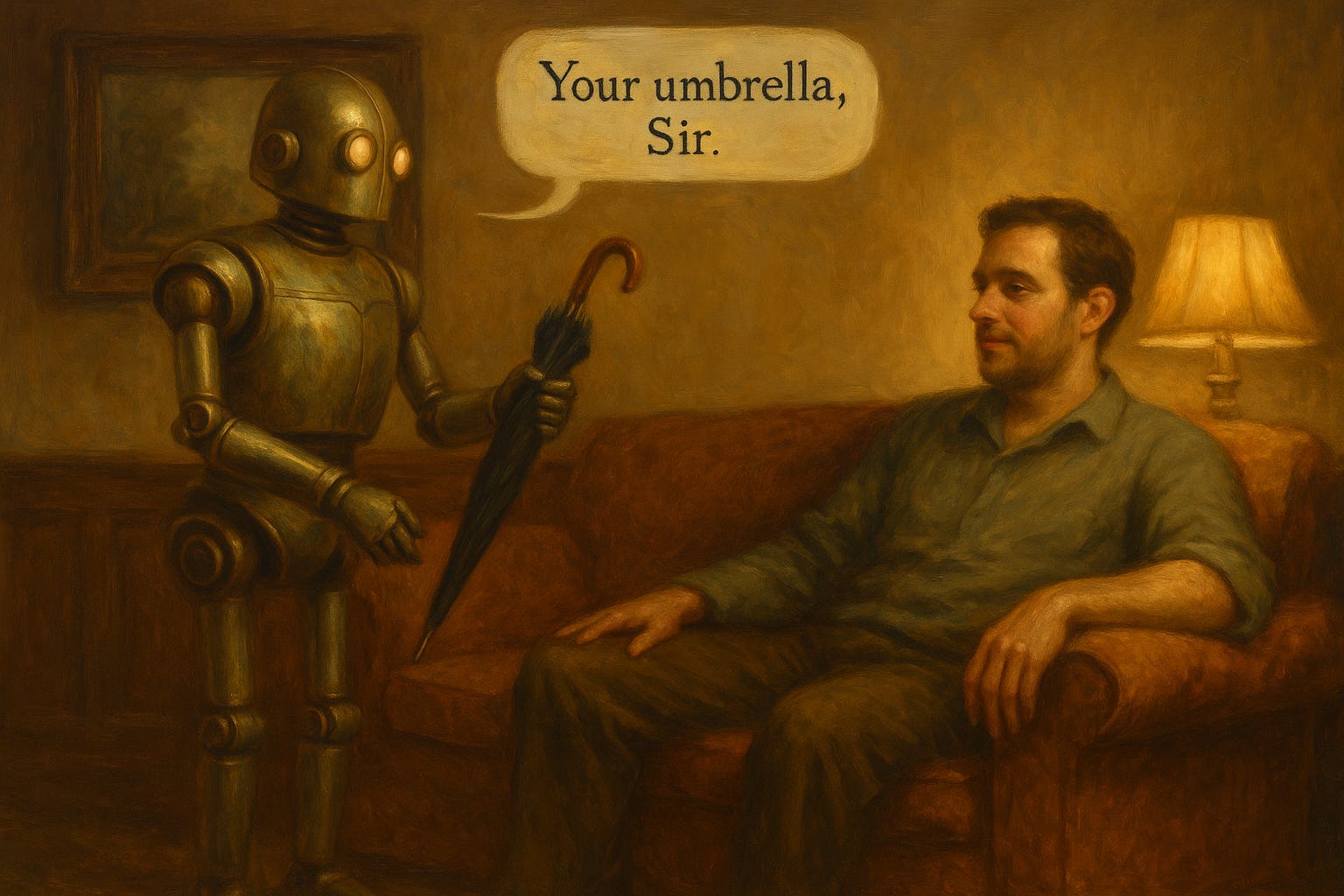
From there, I couldn’t stop.
I moved the setup into Home Assistant running on a Raspberry Pi, and started building more logic on top of it. With one press of the TV remote, the lights dim and the curtains draw themselves closed. Plugging my phone in at night becomes a “goodnight” command — lights off, thermostat down, silence. When my partner leaves the office, I get a small ping on my phone: time to start cooking dinner.
Friends come over and shake their heads. “You’ve lost it,” they say, laughing as the curtains move on their own. But then they stop and ask how it works. Because underneath the absurdity, there’s a kind of elegance. A home that responds, not performs.
I won’t lie: some of it got out of hand. I automated so much that I started automating things I didn’t even need. The system would flick the hallway lights on if it detected motion — even if that motion was my cats. I learned the hard way that automating without purpose doesn’t create freedom. It creates noise.
Not everything should be automatic.
That realization became its own quiet philosophy: find the real pain points, not just the possible ones. The goal isn’t to make everything effortless. It’s to make the right things disappear — the small, predictable frictions that steal focus and attention.

That shift from “make everything automatic” to “make only the right things automatic” became the foundation for how I build systems today.
Now, when I work with teams, I see the same pattern everywhere, their own versions of the umbrella problem. Small, constant frictions that make good work harder than it needs to be. Most teams don’t need new tools, they need invisible systems that clear a path for people to do what they’re already good at.
So we build them.
An employee checks a box, and a real-time Slack notification alerts the next person — no one waiting, no one guessing. When a deliverable goes out, execs who need to know are notified instantly — no chasing, no “just checking in.” Documents that used to take hours to create, sort, and label now generate automatically — clean, uniform, finished in seconds. And for the leaders who need to see the signal through the noise, we build daily briefings, surfacing exactly what matters that morning, and nothing else.
These aren’t magic tricks. They’re acts of respect.
Automation, done right, isn’t about replacing people. It’s about removing the parts of work that make smart people feel stupid.
When you build it right, it feels like the lights dimming as the movie starts — effortless, expected, right on time.

A few months ago, I was standing on the 70th floor of One World Trade Center at a Make.com mixer. Floor-to-ceiling windows stretched across the skyline, the entire city laid out below in perfect grids of light. It was one of those rare moments where you can see the system you’ve been living inside — the movement, the structure, the potential — all at once.
I caught my reflection in the glass and thought about that soaked version of myself outside the grocery store two years earlier, the one trying to solve a $5 problem.
The same curiosity that wanted to stay dry now powers entire systems that keep teams from drowning in their own noise.
I didn’t plan that arc. I just followed the irritation until it turned into something useful.
Solve for one.
Solve what hurts.
That’s how scale actually begins.
